Bishop Mary in the Anglican Diocese of Montreal heeded the call from the Church of England to give up plastic for Lent. As the Diocese of London explained, "This Lent let's give ocean creatures a better chance to renew themselves, free of our trash!"
Each year millions of Christians fast or give up something for Lent. This year many Christians opted to give up single-use plastic because of its destructive environmental impact. More than 300 million tons of plastic is created each year and around half is single-use plastic. A total of 8.3 billion tonnes of plastic has been created since the 1950s.
Much of that waste ends up in our oceans and waterways. Eight tons of plastic is dumped in the sea every minute. This plastic is forming massive plastic patches on the surface called gyres. It is also ubiquitous beneath the waves. This plastic does not biodegrade making it deadly to wildlife. The problem is so vast it is interfering with the aquatic food chain.
Tuesday, April 10, 2018
Sunday, April 1, 2018
Easter and the Environment: Spiritual Transformation
"I used to think the top environmental problems were biodiversity loss, ecosystem collapse and climate change. I thought that with 30 years of good science we could address those problems. But I was wrong. The top environmental problems are selfishness, greed, and apathy." Speth said, adding, "to deal with those we need a spiritual and cultural transformation - and we scientists don't know how to do that." Speth is the dean and professor in the practice of environmental policy and sustainable development at Yale University’s School of Forestry & Environmental Studies.
Monday, March 5, 2018
What Does Nature Mean to You? Let Us know by Completing a Short Survey
What is your connection to nature? The Stewardship of the Environment Committee in the Anglican Diocese of Montreal has created a short survey to help us to get to know more about how people feel about nature and by extension the environment.
We intend to incorporate the results into a series of three videos we are shooting as part of our mission priorities for 2018.
This very brief survey takes only a minute to complete. It is comprised of 10 easy to answer questions about you and your relationship to nature.
Please complete this short survey and consider sharing it with friends. There are no names so your answers will be kept strictly confidential.
To go to the survey click here.
We intend to incorporate the results into a series of three videos we are shooting as part of our mission priorities for 2018.
This very brief survey takes only a minute to complete. It is comprised of 10 easy to answer questions about you and your relationship to nature.
Please complete this short survey and consider sharing it with friends. There are no names so your answers will be kept strictly confidential.
To go to the survey click here.
Thursday, February 8, 2018
The Call to Come Together to Safeguard the Health of the Planet
Faith groups and others must unite to address environmental degradation and climate change. Anglicans are called by the fifth mark of mission to be good stewards of the Earth. Other traditions have come to similar conclusions. Secular society is also actively involved in environmental stewardship. The scope of the problems we face demand that groups work together to safeguard planetary health.
In recent years we have seen the ways in which diverse coalitions including religious organizations are living their convictions as they seek to divest from fossil fuels. We have seen this effort grow at both national and local levels. The rational for divestment in faith communities is powerfullly compelling. The Anglican Diocese of Montreal along with other dioceses across Canada and around the world have passed resolutions to divest from fossil fuels.
Monday, January 22, 2018
Anglican Primates Invited to Share Views on Caring for Creation
The 39 Primates in the Anglican Communion have been asked to share their views about what it means to care for God’s creation. The Primates who together represent tens of millions of people are being encouraged to write about their local environments and our common planetary home. They are invited to include illustrations, photographs, paintings and video. These creations will be featured at the launch of the Global Climate Action Summit which is being held in Grace Cathedral in San Francisco on September 12, 2018. The submissions will also be exhibited in Lambeth Palace during Creationtide (Sept.1 - Oct. 4). Lambeth Palace is the official London residence and offices of the Archbishop of Canterbury. This project will go on display ahead of the Lambeth Conference, God’s Church for God’s World in 2020. The conference is expected to bear witness to the Anglican Communion’s 5th Mark of Mission: "To strive to safeguard the integrity of creation, and sustain and renew the life of the earth."
Saturday, January 20, 2018
New Chair for the Stewardship of the Environment Committee
Richard Matthews has assumed the role of chairperson of the Stewardship of the Environment Committee (SEC). Richard replaces Rev. Elizabeth Welch, the former Parish Priest at St. Andrews and St. Mark’s in Dorval.
Rev. Elizabeth was instrumental in the passage of the fossil fuel divestment motion in the Diocese of Montreal. In addition to her environmental interests Rev. Elizabeth has served as a chaplain in both hospitals and prisons. She obtained a Masters in Religious Studies with a Specialization in Biomedical Ethics from McGill University. Rev. Elizabeth is currently the Rector at St. Georges Anglican Church in Victoria, BC where she lives with her wife, and their daughter.
Tuesday, January 16, 2018
Building Bridges: Stewardship of the Environment Committee's Mission Plans for 2018
The Stewardship of the Environment Committee (SEC) in the Anglican Diocese of Montreal is pleased to share our mission priorities for 2018. We are grateful to serve alongside an increasing number of faith communities that are prioritizing environmental stewardship. This year we will focus on crafting narratives that appeal to shared values. We will do this by telling stories that invite engagement.As we embark on our newest initiatives, the SEC wishes to thank everyone who has supported us over the years, especially the delegates who voted in support of the fossil fuel divestment motion at the 2015 Synod. I am happy to report that as a function of your votes divestment efforts are underway in our diocese.
Sunday, December 24, 2017
Friday, November 24, 2017
What Faith Groups can Teach us about Climate Communications
Climate communication is a complex topic but faith groups provide compelling examples of how it can be done. Rather than facts and figures, faith groups speak in terms of narratives. Climate change adversely impacts us all, especially the poor. ' So independent of environmental justice, this is a powerful social justice issue. "This is the issue of humanity," the Dalai Lama said.
"If you are in church rgualrly you are in the business of looking for moral causes, your there becaus you think your life is better for a spiritual aspect expressed in daily action and climate change, climate activism is a big part of this."
Churches and mosques can teach us a great deal about spreading the climate change message. Leading faith groups have championed the cause of climate action and encouraged their members to engage.
The Guardian explores what climate activist can learn from religion. In addition to its narratives, it specifically explores sacrifice and salvation. It is not about blame it is really ultimately all about love and about actions that articulate that love.
The podcast narrated by Aleks Krotoski and produced by Francesca Panetta, Alannah Chance, Lucy Greenwell, Harriet Green, Jason Phipps. Sound design is by Chris Wood and original music by Matthew Herbert
Click here to go to the podcast
"If you are in church rgualrly you are in the business of looking for moral causes, your there becaus you think your life is better for a spiritual aspect expressed in daily action and climate change, climate activism is a big part of this."
Churches and mosques can teach us a great deal about spreading the climate change message. Leading faith groups have championed the cause of climate action and encouraged their members to engage.
The Guardian explores what climate activist can learn from religion. In addition to its narratives, it specifically explores sacrifice and salvation. It is not about blame it is really ultimately all about love and about actions that articulate that love.
The podcast narrated by Aleks Krotoski and produced by Francesca Panetta, Alannah Chance, Lucy Greenwell, Harriet Green, Jason Phipps. Sound design is by Chris Wood and original music by Matthew Herbert
Click here to go to the podcast
Sunday, November 19, 2017
Anglicans and the Environment: Creation Matters
Did you know that Anglicans are concerned about and engaged in environmental issues? Did you know that Creation Matters, The Anglican Church of Canada’s, environmental task group, wants to connect with interested Anglicans and share information via social media?
In many parts of the world local Anglican Churches have given leadership by being advocates for responsible environmental stewardship. They are also providing support and leadership to local initiatives to protect the environment and by seeking to educate Anglicans as individuals and as communities to become better stewards of creation.
Click here to connect with them on Facebook
To go to the Creation Matters site click here.
Creation Matters is premised on the 5th Mark of Mission: "To strive to safeguard the integrity of creation and sustain and renew the earth." Similarly, the Stewardship of the Environment Committee in the Anglican Diocese of Montreal derives it core mandate from the same place. To see our full mandate see the right side of this page.
In many parts of the world local Anglican Churches have given leadership by being advocates for responsible environmental stewardship. They are also providing support and leadership to local initiatives to protect the environment and by seeking to educate Anglicans as individuals and as communities to become better stewards of creation.
Click here to connect with them on Facebook
To go to the Creation Matters site click here.
Creation Matters is premised on the 5th Mark of Mission: "To strive to safeguard the integrity of creation and sustain and renew the earth." Similarly, the Stewardship of the Environment Committee in the Anglican Diocese of Montreal derives it core mandate from the same place. To see our full mandate see the right side of this page.
Monday, November 13, 2017
Faith-based investing is about more than avoiding sin stocks
While talking investing, Sameer Azam brings up the subject of halal meat. Islamic rules known as halal specify the procedures for slaughtering an animal, and they vary among the Muslim traditions.
Faith-based investing is similar, says Mr. Azam, senior wealth manager at Absolute Wealth Management in Mississauga. Basic tenets apply, but they’re open to interpretation and degrees of strictness. For instance, halal investing screens out companies that sell tobacco, alcohol and other obvious vices. Also excluded are companies making money by charging interest. So no bank stocks.
Saturday, November 4, 2017
Entitlement and Creation
I’ve known that I wanted to do a post about the environment for a while, but I haven’t really known what to say. Not because there’s nothing to say, but because it’s all been said so many times by so many people who know way more about it than I do.
Basically, we either get serious about being a sustainable part of creation, or we watch our behaviour degrade and destroy the stuff of which we’re made.
It seems like a pretty simple choice, but we seem to unable to make it.
As a church, we haven’t been helped by the language of dominion that we find in scripture. The creation story of Genesis puts human beings at the centre and peak of creation. It describes a particular kind of relationship with the rest of creation that has too easily slipped from dominion over something that was never ours to begin with to domination over something to which we feel entitled.
Basically, we either get serious about being a sustainable part of creation, or we watch our behaviour degrade and destroy the stuff of which we’re made.
It seems like a pretty simple choice, but we seem to unable to make it.
As a church, we haven’t been helped by the language of dominion that we find in scripture. The creation story of Genesis puts human beings at the centre and peak of creation. It describes a particular kind of relationship with the rest of creation that has too easily slipped from dominion over something that was never ours to begin with to domination over something to which we feel entitled.
Thursday, November 2, 2017
American Christians on Climate Change: It is Not as Bad as You Might Think
The climate denial we see in Donald Trump and the GOP is not a true reflection of the sentiments of most American Christians. While support for climate denial is evenly split among evangelicals the clear majority of most other Christian denominations think climate change is real. Almost 70 percent of Catholics think climate change is real which is higher than the percentage of Americans in the general population as a whole. Around 62 percent of non-evangelical Protestants think climate change is real. Even more uplifting is the finding that between 73 and 83 percent of Christians support policies that help combat climate change. This includes tax rebates for people who purchase energy-efficient vehicles & solar panels, and research funding for renewable energy. A clear majority indicated that they favor requiring electric utilities to produce at least 20 percent of their electricity from wind, solar, or other renewable energy sources. These numbers hold even if it costs the average household an extra $100 a year. American Christians also express strong support for strict carbon dioxide limits on coal-fired power plants. Sadly, the EPA's Clean Power Plan is being dismantled by the Trump administration.
Most American Christians agree with the statement that "God expects people to be good stewards of nature, which is not only here for human use" over the more literal biblical interpretation that, "God expects people to rule over nature, which is here for human use." More than 80 percent of Catholics, Protestants, and evangelicals say it is important to them personally to care for future generations. A solid majority (63% - 73%) believe we must tend to the world’s poor.
These are some of the findings in a study titled, "Climate Change in the American Christian Mind" which was derived from a national survey of global warming opinion. To download the report click here.
Most American Christians agree with the statement that "God expects people to be good stewards of nature, which is not only here for human use" over the more literal biblical interpretation that, "God expects people to rule over nature, which is here for human use." More than 80 percent of Catholics, Protestants, and evangelicals say it is important to them personally to care for future generations. A solid majority (63% - 73%) believe we must tend to the world’s poor.
These are some of the findings in a study titled, "Climate Change in the American Christian Mind" which was derived from a national survey of global warming opinion. To download the report click here.
Sunday, September 24, 2017
Pope Francis Calls Everyone to Pray and Act During the Season of Creation
The Season of Creation takes place from September 1 to October 4 October. Pope Francis is calling Christians of all traditions and on all continents to make a special time for prayer, reflection and care for Creation.
September 1st was proclaimed as a day of prayer for the environment by the late Ecumenical Patriarch Dimitrios I in 1989. The Orthodox church year starts that day with a commemoration of how God created the world. On 4 October, Roman Catholics and other churches from the Western traditions commemorate Francis of Assisi, known to many as the author of the Canticle of the Creatures. The proposal to celebrate a "Time for Creation" during these five weeks was made by the Third European Ecumenical Assembly in Sibiu in 2007. Pope Francis designated September 1st as a World Day of Prayer for Care of Creation for the worldwide Roman Catholic Church in 2015.
Thursday, September 7, 2017
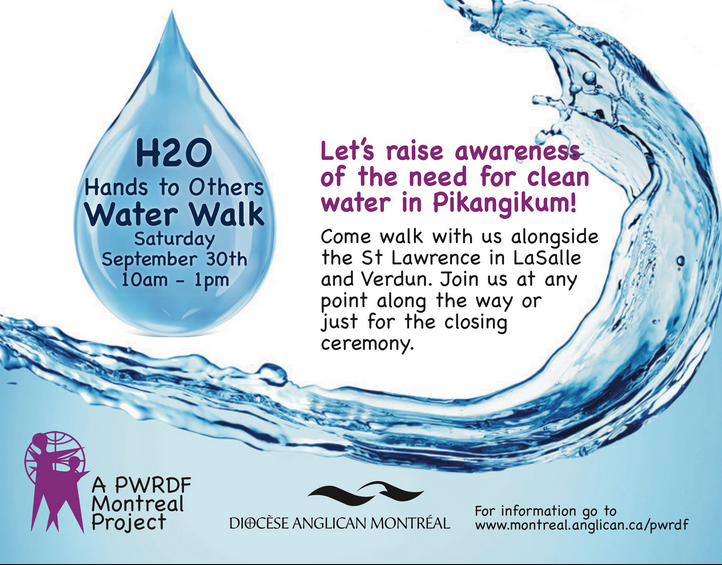
PWRDF Water Walk: Anglican Diocese of Montreal
Please plan to join us on September 30th for awareness raising, exercise, and fun at the H2O (Hands to Others) PWRDF Water Walk!
Why: to raise awareness of the need for clean water in Pikangikum & other first nations communities and to encourage donations, through PWRDF, to help provide necessary clean water.
When: Saturday, September 30th from 10 am to 1 pm. There will be a brief initial send-off at 10:00 am, but feel free to begin walking anytime between 10 am and 11 am depending on your pace. You may also join the Walk at any spot along the way.
Why: to raise awareness of the need for clean water in Pikangikum & other first nations communities and to encourage donations, through PWRDF, to help provide necessary clean water.
When: Saturday, September 30th from 10 am to 1 pm. There will be a brief initial send-off at 10:00 am, but feel free to begin walking anytime between 10 am and 11 am depending on your pace. You may also join the Walk at any spot along the way.
Tuesday, September 5, 2017
Fossil Fuel Divestment Webinar: Catholic Divest Toolkit
A fossil fuel divestment webinar focusing on the link between divestment and mission will take place on September 6, 2017 – 10am NYC / 3pm GMT/ 4pm Rome/ 4pm South Africa. It is titled, "Prophetic Actions and Voices on Fossil Fuels and Climate Justice: Silent Disinvestment or Public Divestment?"
The webinar will present the new Catholic Divest toolkit. It provides practical information on divestment and on fossil free investment. This webinar is part of Catholic Season of Creation events. For resources on staging a Season of Creation event click here.
The aim is to raise the issue of going public with divestment decisions for the next Joint Catholic announcement on October 4, 2017 having prophetic voice.
The webinar will present the new Catholic Divest toolkit. It provides practical information on divestment and on fossil free investment. This webinar is part of Catholic Season of Creation events. For resources on staging a Season of Creation event click here.
The aim is to raise the issue of going public with divestment decisions for the next Joint Catholic announcement on October 4, 2017 having prophetic voice.
Monday, September 4, 2017
Resources for Planning a Season of Creation Event
Here are some resources for those interested in staging a Season of Creation event. This celebration calls Christians of all traditions and on all continents to make a special time for prayer, reflection, and care for Creation. Hundreds of events will take place during the course of this celebration that runs from September 1 to October 4.
September 1st was proclaimed as a day of prayer for the environment by the late Ecumenical Patriarch Dimitrios I in 1989. The Orthodox church year starts that day with a commemoration of how God created the world. On 4 October, Roman Catholics and other churches from the Western traditions commemorate Francis of Assisi, known to many as the author of the Canticle of the Creatures.
Sunday, September 3, 2017
The WCC and the Season of Creation
The World Council of Churches (WCC) is a stalwart supporter of the Season of Creation which takes place from September 1 to October 4. This special season calls the world's 2.2 billion Christians of all traditions and on all continents to make a special time for prayer, reflection and care for Creation. Hundreds of events will take place during over the course of the coming month.
Friday, June 2, 2017
Presiding Episcopal Bishop responds to Trump’s decision to pull U.S. out of worldwide climate accord
President Donald Trump announced June 1 that he would pull the United States out of the Paris Agreement, a 2015 pledge to limit climate change signed by 196 nations.
The agreement includes a plan to decrease carbon emissions and limit global warming to 2 degrees Celsius, and a commitment from wealthier nations to provide $100 billion in aid to developing countries. The agreement is the first-ever binding, international treaty in 20 years of United Nations climate talks.
The presiding bishop’s statement follows.
The agreement includes a plan to decrease carbon emissions and limit global warming to 2 degrees Celsius, and a commitment from wealthier nations to provide $100 billion in aid to developing countries. The agreement is the first-ever binding, international treaty in 20 years of United Nations climate talks.
The presiding bishop’s statement follows.
Paris climate deal exit 'deeply troubling' to Catholic leaders
Despite urging from allies, corporate leaders' last-minute calls and even a not-so-subtle gift from the pope, President Donald Trump on Thursday announced he would withdraw the United States from the landmark Paris Agreement on climate change.
With the announcement, Trump removes the United States — the world's second-largest present-day polluter, and the largest historical emitter of greenhouse gases — from the first-of-its-kind international pact that commits countries to curbing climate change. In December 2015 in Paris 195 nations signed the deal in a bid to keep global warming between 1.5 and 2 degrees Celsius (3.6 degrees Fahrenheit) — the point at which scientists predict the devastating effects of climate change, such as sea level rise, increased drought and more frequent, intense storms, would become most severe and potentially irreversible.
Subscribe to:
Posts (Atom)