Sunday, November 29, 2015

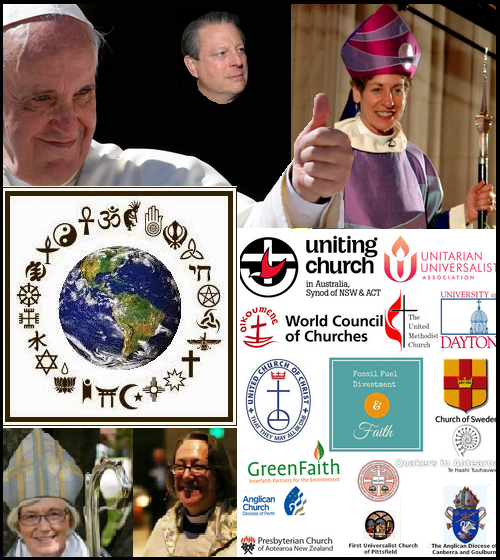
Statement of Faith and Spiritual Leaders on COP21

Here is a Statement from dozens of Faith and Spiritual Leaders on the upcoming United Nations Climate Change Conference, COP21 in Paris in December 2015

We raise our voices to the governments represented at COP21 in Paris to utilize the special momentum given on this highly significant occasion: COP21 provides a critical opportunity to benefit the whole of the human community. For the first time in over 20 years of UN negotiations, a global and comprehensive agreement on climate justice and climate protection – supported from all the nations of the world – can be reached.

Saturday, November 28, 2015

COP21: Pope's adviser urges Catholics to join climate marches

The Pope's closest adviser on ecology has urged Catholics to join global climate marches planned for Sunday. In an internal letter to bishops, Cardinal Peter Turkson says people should be "encouraged" to exercise their "ecological citizenship".

The letter says that climate negotiators meeting in Paris need to hear the voice of "God's people". Activists say the call is evidence of a step-change in the Church's approach to climate change. Major demonstrations across the world have been planned to mark the start of the global climate conference, known as COP21.

Thursday, November 26, 2015

Path to Paris Mary Knoll

November is a historic month for taking action on climate change. Nearly 200 nations will join the UN Climate Summit in Paris, starting November 30. We need them to take bold action and solve the current climate crisis. To help you join the millions of people worldwide praying and acting for the care for the earth, the Maryknoll Office for Global Concerns will offer a weekly series, Path to Paris.

Each week, a two-page prayer-study-action guide will examine the devastating impacts of climate change and what we can do, leading up to the UN Climate Summit in Paris. The Path to Paris series in response to Pope Francis’ call: “Our goal is not to amass information or to satisfy curiosity, but rather to become painfully aware, to dare to turn what is happening to the world into our own personal suffering and thus to discover what each of us can do about it.” (Laudato Si' 19) Share each issue of Path to Paris with your parish and friends; and use it for personal reflection.

Click here to go to see the prayer study action guides. 

Saturday, November 21, 2015

COP21 Paris Primer for People of Faith

France will be hosting the 21st Session of the Conference of the Parties to the United Nations Framework Convention on Climate Change COP 21 from November 30th to December 11th. COP21 will be a crucial conference, as it needs to achieve a new international agreement on the climate, applicable to all countries, with the aim of keeping global warming below 2°C.

The Conference of the Parties (COP), made up of all “States Parties”, is the Convention’s supreme decision making body. It meets every year in a global session where decisions are made to meet goals for combating climate change. The COP in Paris will be the 21st, hence the name “COP21”.

Christians from Paris and the surrounding region, climate pilgrims from the UK and many other countries, faith leaders, agencies and NGOs will be taking part. The Council of Christian Churches of France is encouraging all Christians to support the conference through common prayer.

Thursday, November 19, 2015

Fossil Fuel Divestment Presentation Delivered at the Synod of the Anglican Diocese of Montreal

On October 16th, 2015 a fossil fuel divestment motion was passed at the synod of the Anglican Diocese of Montreal. Here is the presentation that was delivered in support of the motion.
___________________________________________


DIVESTMENT PRESENTATION
By Richard Matthews

The Stewardship of the Environment committee's divestment motion is inspired by the call to care for creation. The fifth Mark of Mission and our sixth Baptismal Covenant specifically call us to:

Thursday, November 12, 2015

Combating Climate Change as a Moral Imperative

The moral call to act on climate change has grown and it is resonating around the world. Morality is a powerful force that transcends politics, race, ethnicity, gender and geography. Religions are making a moral argument and faith groups around the world are calling for ambitious climate action. This morality is also inspiring them to divest their holdings from fossil fuels.

Pope Francis’ environmental encyclical is an important catalyst for religious activism in support of climate action. The science based encyclical highlights efforts to combat climate change as a moral issue and calls us to replace fossil fuels with renewable energy.

Tuesday, November 10, 2015

350.org Coverage of the Divestment Motion in the Anglican Diocese of Montreal

On October 16th, the Synod of the Anglican Diocese of Montreal passed the following motion to divest from the top 200 worst fossil fuel polluters.

Moved: Raymond Noel
Seconded: Elizabeth Welch

Monday, November 9, 2015

The President of the CCC Sends Letter to Justin Trudeau Commending him for his Statements on Climate

On November 4, 2015, Canon Dr. Alyson Barnett-Cowan, President of the Canadian Council of Churches (CCC), wrote to Prime Minister Justin Trudeau to congratulate him on taking office, and to commend to him the statement On Climate Justice and Ending Poverty in Canada: Faith Communities Speak Out. PM Justin Trudeau

This statement now represents the broadest and deepest coalition yet of religious leaders in Canada on the topics of climate, poverty, and Indigenous Peoples in Canada.

Friday, November 6, 2015

Montreal Anglicans Vote to Divest from Fossil Fuels

Here is an article on the fossil fuel divestment motion brought forward by the Stewardship of the Environment Committee. It was passed at the synod of the Anglican Diocese of Montreal on October 16, 2015. 
___________________________________

The Anglican Diocese of Montreal is working on ways to sell off, or “divest,” shares and other investments in coal, oil and gas companies from the diocesan investment portfolio.

Sunday, November 1, 2015

Anglican Diocese of Ottawa Votes to Divest from Fossil Fuels

Ottawa-area Anglicans voted almost unanimously Friday to sell their $1 million worth of oil and gas stocks and push the church’s national body to do the same.

Local Anglican congregations have a combined stock portfolio worth $30 million, which is administered centrally, and although the oil and gas stocks are a relatively small portion, Friday’s vote is seen as a major statement on climate change.

Bishop John Chapman supported the decision.

“When a person is being baptized in the Anglican Church, they promise that they ‘will live to safeguard the integrity of God’s creation, and respect, sustain and renew the life of the Earth,’ ” he said. “I think our obligations are quite clear.”

Monday, October 26, 2015

The Anglican Diocese of Montreal Votes to Divest from Fossil Fuels

The Anglican Diocese of Montreal Votes to Divest from Fossil Fuels On Friday October 16, 2015, the Diocese of Montreal voted by an overwhelming margin to divest from fossil fuels at their annual synod. The motion was advanced by the Stewardship of the Environment Committee. The motion specifically called for divestment from the Carbon Underground 200, a list of the dirtiest coal and oil companies in the world.

Montreal is the first Anglican diocese in Canada to pass such a divestment motion. Although others have voted to study divestment, Montreal is the first diocese to pass a motion with specific actionable plans that must be executed in a "timely" fashion.

Friday, October 16, 2015

Faith Communities and Divestment and the Canadian National Election in 2015

The movement to divest from fossil fuels and invest in renewable energy and climate solutions has exploded, growing fifty-fold in the past year. To date, 430 institutions and 2,040 individuals across 43 countries and representing $2.6 trillion in assets have committed to divest from fossil fuel companies.

Faith communities cannot, in good conscience, be strong advocates for addressing climate change while continuing to profit from fossil fuel companies. As Archbishop Desmond Tutu has said, “[p]eople of conscience need to break their ties with corporations financing the injustice of climate change.”

Thursday, October 15, 2015

Facts Sheet: Five FAQ about the Motion to Divest from Fossil Fuels in the Anglican Diocese of Montreal

The Divestment Motion for the Anglican Diocese of Montreal reads as follows:

"Be it resolved that synod direct the Finance Standing Committee and its advisers to explicitly examine Diocesan investment and its implications on climate change, and to divest from those companies known to be the worst polluters as published in the "Carbon Underground 200," an annually updated list of the top 100 public coal companies globally and the top 100 public oil and gas companies globally, as ranked by the potential carbon emissions content of their reported reserves. The list is produced and maintained by Fossil Free Index."

Tuesday, October 13, 2015

In Addition to Faith Communities Fossil Fuel Divestment is of Interest to Investors Businesses and Power Companies

Faith communities have been at the forefront of the fossil fuel divestment movement, but they are not alone. As reviewed in this article, investors, businesses and even power companies are acting in response to divestment.
______________________________

The fossil fuel divestment movement is gaining serious traction and resonating widely. Divestment is at the forefront of efforts to manage climate impacts, and due to concerns about growing financial and reputational risks, investors, businesses and power companies are being forced to take notice.

While many initially dismissed divestment from fossil fuels as purely symbolic there is growing reason to believe that it is powering meaningful change. To date we have seen a total of 2.6 trillion divested from fossil fuels and the movement continues to grow. In the last year alone there has been a 50 fold increase in divestment activity.

Friday, October 9, 2015

Report on Faith Based Divestment from Fossil Fuels

Here is an except focused on faith based divestment from fossil fuels. It is taken from a report called, "Measuring the Growth of the Global Fossil Fuel Divestment and Clean Energy Investment Movement":

Faith communities worldwide continue to divest—and are helping shift the climate debate to one grounded in a moral responsibility, bolstering the divestment and investment movement.

Thursday, October 8, 2015

Islamic Leaders Call for a Phaseout of Fossil Fuels and More Renewables

Islamic leaders from 20 nations called for the phaseout of greenhouse-gas emissions from burning fossil fuels and for 100 percent of energy to come from renewables in an effort to rein in more dangerous levels of global warming. The clerics and scholars appealed to “well-off nations and oil-producing states” to recognize their “moral obligation to reduce consumption so that the poor may benefit from what is left of the Earth’s non-renewable resources,” according to the declaration e-mailed Tuesday from Istanbul.

Wednesday, October 7, 2015

Why I Support the Divestment from Fossil Fuels Motion in the Anglican Diocese of Montreal

This article was written by Stewardship of the Environment Committee member Brooke Struck,  in support of a motion to divest from fossil fuels. Delegates and clergy will vote on the motion at the Synod of the Anglican Diocese of Montreal on October 16th 2015.
________________________________

The climate has always been changing, and life (including human life) has always had to adapt. Some organisms have succeeded, and have survived; others haven’t. But the present change in climate is much more rapid, exerting much stronger adaptive pressures on humanity and the rest of our living brethren on Earth. The main driver of climate change is carbon emissions from human sources, primarily since the Industrial Revolution. (For a very illustrative set of graphs about attributing climate change to various factors, recently assembled to include massive amounts of scientific data from wide-ranging sources click here).

Friday, October 2, 2015

Anglican Bishops Call for Urgent Action on Climate Justice

In March 2015, 17 Anglican bishops from six continents met at a summit in Cape Town, South Africa to discuss how Anglicans could respond to climate change. Their talks eventually led to a written declaration, The World is Our Host: A Call to Urgent Action for Climate Justice.

For the Rev. Canon Ken Gray—rector of the Church of the Advent in Colwood, B.C., co-chair of the Creation Matters Working Group for the Anglican Church of Canada, and secretary of the Anglican Communion Environmental Network—one word in the declaration seemed to strike a particular chord for readers: “urgent.”

“It is a theological and spiritual challenge for us now to face, immediately and urgently, concerning the way we have stewarded creation and the way we’re currently using it,” Gray said. “There, I think, is … growing distrust [in] neoliberal market economics as being able or willing to provide real solutions to real problems.”

Tuesday, September 22, 2015

WCC at International Divestment Conference in Paris

With just two months before the crucial United Nations Climate Change Conference (COP 21), an International Divestment Conference was held in Paris, on 1 September, where Rev. Henrik Grape represented the World Council of Churches (WCC) as a key speaker.

“The logic of divestment couldn’t be simpler: if it’s wrong to wreck the climate, it’s wrong to profit from that wreckage,” said Grape.

The conference focused on the growing movement to withdraw investments from fossil fuels that create emissions causing climate change, and to invest in sustainable energy.

Thursday, September 3, 2015

Climate Change and Faith: Why We Are Asking the Diocese to Divest from Fossil Fuel

Careful research over many years has revealed a difficult truth: carbon emissions from human sources are the primary driver of climate change that is threatening ecosystems and people.1 This truth is difficult because since the 19th century carbon has fueled industry and it is now tightly woven into many aspects of our daily life. Transitioning to a low-carbon economy seems daunting. However, this is a necessary transition to make. Experts agree with very high confidence that climate change will “increase risks for people, assets, economies and ecosystems, including risks from heat stress, storms and extreme precipitation, inland and coastal flooding, landslides, air pollution, drought, water scarcity, sea level rise and storm surges . . . these risks are amplified for those lacking essential infrastructure and services or living in exposed areas.”2 Let us not allow cynicism and despair to lead to apathy, even in the midst of crisis we as people of faith are called to hopeful acts of self-giving love.